Whether it’s a customer service chatbot, Copilot in everyday work, or AI-supported procurement, companies are increasingly using artificial intelligence in their business processes. Innovation and efficiency are usually the main priorities. But AI must also be used responsibly and securely. Which requirements apply is often unclear. The EU AI Act, ISO/IEC 42001:2023, the NIST AI Risk Management Framework, and the BSI’s A5 audit framework differ in how binding they are and in what they focus on, but they also overlap in many areas. Industry and operating context can bring additional requirements, such as DORA or PCI DSS.
Those responsible for AI use face two questions: Which requirements apply to our use of AI? And how close are we to meeting them with our existing processes and measures?
We discuss these questions with Maximilian Müller, Principal usd Security Consulting | AI Governance:

How Does a Company Determine Which Requirements Apply to Its Use of AI?
Maximilian Müller: Three factors determine which requirements apply to a company’s use of AI: the company itself, the context in which it uses AI, and the specific use case.
We start with the company itself. Anyone who provides or uses AI in the EU is generally subject to the EU AI Act. Other requirements may apply depending on the country and industry.
We also consider the context in which AI is used. DORA may be relevant to financial companies. If an AI system processes card data, PCI DSS also applies. Companies may also adopt standards such as ISO/IEC 42001:2023 voluntarily because customers ask for them or because such standards have proven to be best practice.
The key is then to analyze the specific use case: What tasks does the AI system perform, and which risk category does it fall into? A customer service chatbot and a system that reviews and pre-sorts job applications are subject to different obligations and requirements.
The result is a clear picture of which requirements apply to the company’s use of AI. This is the foundation for AI governance: the rules, processes, and responsibilities a company uses to manage AI securely, responsibly, and in compliance with applicable requirements.
How Can a Company Keep Track of Requirements across Multiple AI Frameworks?
Maximilian Müller: The best way for a company to keep track of AI requirements is to consolidate the requirements from different frameworks into a single framework. Many of them ask for essentially the same things, but approach them from different perspectives.
These frameworks take different approaches. The EU AI Act sets out regulatory requirements. ISO/IEC 42001:2023 specifies requirements for an AI management system. The NIST AI Risk Management Framework helps organizations manage AI risks. With A5, the BSI also provides criteria and methods for assessing the trustworthiness of AI systems.
The main areas of overlap are AI risk management, clear responsibilities, and traceable documentation. Instead of working through each requirement separately with the client, we consolidate them into an AI Multi-Compliance Framework tailored to the company.
From this, we derive a set of internal AI requirements, each of which addresses multiple internal or external requirements. For example, a single requirement for AI risk assessment meets requirements from the EU AI Act, ISO/IEC 42001:2023, and the NIST AI RMF. The company therefore only needs to implement it once and provide evidence of its implementation once.
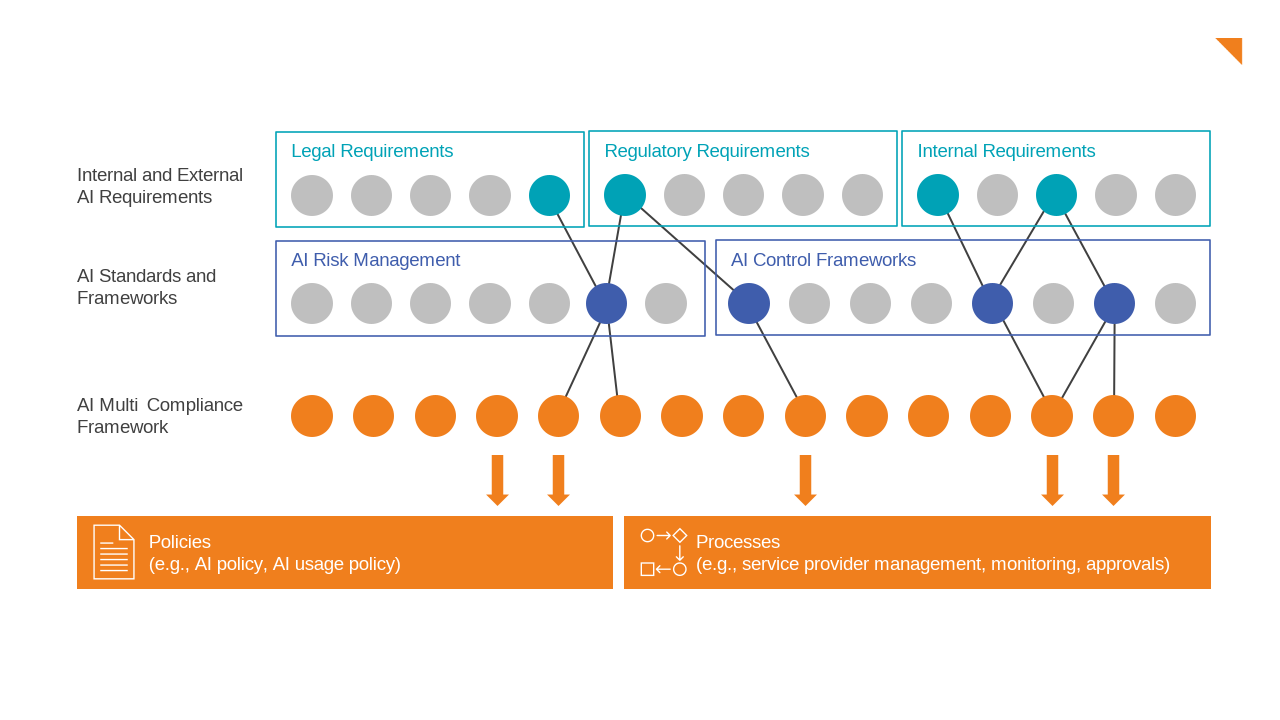
For each internal requirement, we record who is responsible for it and what evidence demonstrates its implementation. It also remains possible to trace each requirement back to its source framework. This gives the company a common basis for managing its use of AI, even as new use cases arise or requirements change.
How Can a Company Assess the Maturity of Its AI Governance?
Maximilian Müller: A gap analysis shows how mature a company’s AI governance is. It comes first, before the company builds its AI Multi-Compliance Framework, and identifies the structures and internal requirements already in place for its use of AI. Most companies have established governance, risk, compliance, and security structures that already address many requirements in part or in full.
The analysis shows which processes, roles, and measures are already working and where gaps remain. The AI Multi-Compliance Framework builds on these findings: It incorporates existing internal requirements and supplements them with new requirements derived from the framework.
Does AI Governance Require Yet More Processes and Structures?
Maximilian Müller: AI governance does not necessarily require new processes. Often, it is enough to extend what is already in place, for example by incorporating AI-specific risks into risk management. The goal should be to reuse existing structures, such as those in the ISMS, and keep the effort required for implementation and operation to a minimum. New structures or processes are needed only where none are in place. Step by step, this creates an integrated management system in which shared processes address multiple frameworks at once.
How Can You Check Whether AI Governance Requirements Are Implemented Effectively?
Maximilian Müller: Effective AI governance means regularly checking whether the requirements in place work in practice. ISO/IEC 42001:2023, for example, calls for internal audits. The assessment is based on the requirements the company has defined for its use of AI and the evidence intended to demonstrate their implementation.
An AI Audit looks at the organizational side: Are the processes followed? Is the evidence available? Are responsibilities clear? A Pentest of AI/LLM Systems complements the audit by examining the technical side: What vulnerabilities and avenues of attack exist in a given AI system? Only together do these two assessments show whether the company’s AI governance works beyond what is documented on paper.
Is It Worth Starting on AI Governance Now Despite the Postponed EU AI Act Deadlines?
Maximilian Müller: It’s worth getting started with AI governance now. The postponement under the Digital Omnibus on AI affects only the obligations for high-risk AI systems, not the entire EU AI Act.
Other obligations already apply. For example, companies must ensure that their employees have a sufficient level of AI literacy. This obligation also applies to companies that “only” use tools like Copilot or ChatGPT.
There is also the reality inside companies: Business units are often already using AI tools (Shadow AI) without anyone having a clear picture of what data those tools process. At the same time, customers and partners are increasingly asking how companies secure their AI.
AI governance isn’t built overnight. Companies that start now can integrate it into existing structures step by step instead of scrambling to make changes just before the deadline.
What Advice Would You Give Companies That Want to Get Started Now?
Maximilian Müller: The first step toward AI governance is to take stock: Which AI systems are in use, what are they used for, and what role does the company play? This helps identify both the risks and the relevant requirements. These form the basis for all further measures.
Would you like to know which requirements apply to your use of AI and where you stand today? Together, we review your AI use cases, assess your existing structures, and identify where action is needed. Get in touch.
About the Expert: Maximilian Müller
Maximilian Müller is Principal usd Security Consulting, specializing in information security and AI governance. He helps companies integrate requirements from frameworks such as the EU AI Act, ISO/IEC 42001:2023, and the NIST AI Risk Management Framework into existing governance, risk, compliance, and security structures.