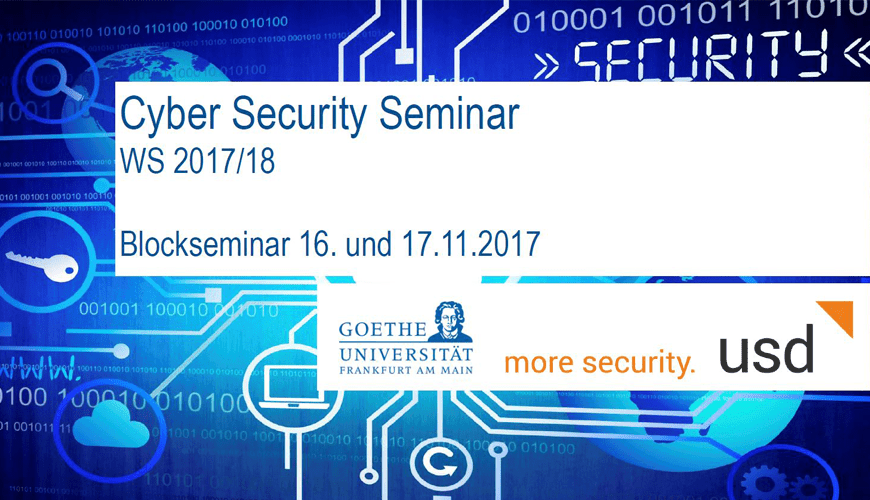
This year’s Cyber Security Seminar hosted by Goethe University Frankfurt and usd AG concluded on 17 November. The closing event was held in usd AG’s premises in Neu-Isenburg.
The seminar links theoretical and practical questions. It offers students of the Institute for Information Systems the opportunity to familiarise themselves with the human, regulatory and industry-specific aspects of cyber security.
During this year’s seminar blocks, the topics of cloud computing security, information security management, security compliance management, information security awareness and information security insurance were covered. Furthermore, usd penetration testing specialists performed live hacking demonstrations that gave students a vivid impression of the reality of current cyber threats.
Dr Kai Schubert, Managing Security Consultant at usd AG, commented after the event: “We are very happy to see that the interest in cyber security among students was great again this semester. The increasing digitalisation seen in all business divisions causes the importance of cyber security to grow more and more. As a consultation firm and auditor in this sector, we bear a lot of responsibility. Through the usd Akademie, we continue to get involved in higher education at universities and universities of applied sciences to incorporate cyber security into teaching concepts at an early stage.”
Professor Dr Wolfgang König of Goethe University Frankfurt, Head of usd Akademie, sees the right steps being taken: “In light of the rising cyber threat level, experts and decision-makers from the sectors of business, politics and science must join their efforts and become active together. Sharing knowledge and experience is an important foundation for that. With its involvement in events, panel discussions, lectures and seminars, the usd Akademie strives to provide an appropriate platform.”

Part-IS in Practice: Why the Real Work Starts Now
Since Part-IS took full effect on 22 February 2026, a common pattern has emerged across many organizations: The necessary guidelines have been drafted, processes documented, internal audits completed, and the first review by the regulatory authority is just around the...